

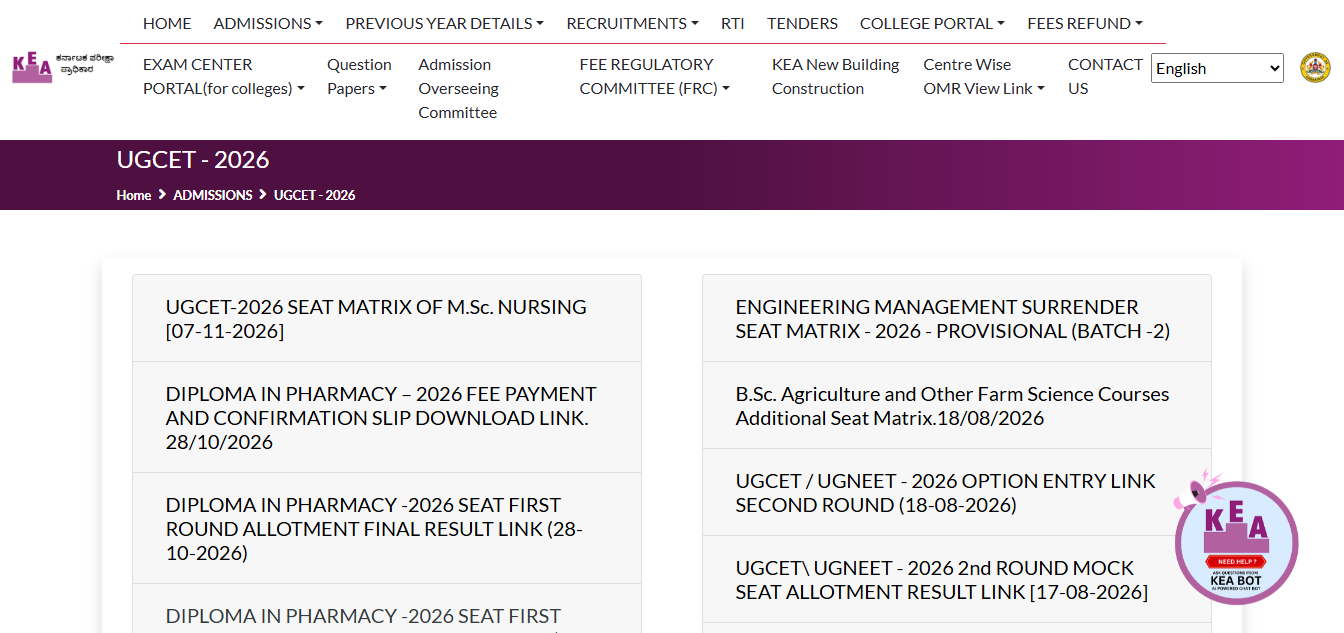
Karnataka Examinations Authority (KEA) conducts the Karnataka Common Entrance Test (KCET), also known as UGCET every year. KCET 2027 serves as a gateway for Class 12 qualified students to secure state‑quota seats in professional programs such as engineering, pharmacy, farm science, and veterinary courses offered by leading institutes across Karnataka.
KCET is among the most competitive entrance exams in South India, comparable to AP EAMCET, TS EAMCET, and KEAM. This KCET 2027 guide covers all essential details, including the admission process, eligibility criteria, exam pattern, syllabus, and marking scheme. Aspirants planning to apply for the upcoming session will find this resource highly useful for structured preparation.
KCET 2027 Highlights
Check out the key highlights of the KCET 2027 in the table below:
| Particulars | Related Details |
| Exam Name | Karnataka Common Entrance Test (KCET) |
| Conducting Body | Karnataka Examinations Authority (KEA) |
| Type of Questions | Multiple Choice Questions |
| Purpose of Exam | Admission to Bachelor’s Programs (B.Pharma, B.Tech., MBBS, B.Arch) |
| Exam Type | State Level Entrance Exam |
| Medium of Paper | Kannada or English |
| Occurrence of Exam | Once a Year |
| Mode of Exam | Offline (Pen & Paper Entrance Test) |
| Exam Duration | 80 Minutes |
| Total No. of Questions | 180 MCQs (60 Questions in Each Section) |
| Subject-Wise No. of Questions | Mathematics: 60 MCQs
Chemistry: 60 MCQs Physics: 60 MCQs |
| Marking Scheme | No negative marking
-1 mark for each correct answer |
| Official Website | https://cetonline.karnataka.gov.in/kea/ |
KCET 2027 Dates
Check out the expected dates for the KCET 2027 examination:
| Events | Dates |
| KCET 2027 Official Notification | Mid-January 2027 |
| KCET 2027 Registration Starts | Mid-January 2027 |
| KCET 2027 Registration Deadline | Late February 2027 |
| KCET 2027 Application Correction Window | Mid-to-Late March 2027 |
| KCET 2027 Admit Card | Mid-April 2027 |
| KCET 2027 Exam Date | Third/Fourth Week of April 2027 |
| Kannada Language Test (For Horanadu/Gadinadu candidates) | One day before or after the KCET exam |
| KCET 2027 Provisional Answer Key & Objections | First week of May 2027 |
| KCET 2027 Result Declaration & Final Rank List | Late May / Early June 2027 |
KCET 2027 Eligibility Criteria
KCET 2027 eligibility requires candidates to have passed Class 12 (PUC II) with Physics and Mathematics as compulsory subjects, plus one optional subject like Chemistry, Biology, Electronics, or Computer Science. They must also meet Karnataka domicile rules (minimum 7 years of study in the state) and secure at least 45% aggregate marks (40% for reserved categories).
| Eligibility Criteria | Details |
| Educational Qualification | Must have passed 2nd PUC/Class 12 with Physics & Mathematics as compulsory subjects, along with Chemistry/Biology/Electronics/Computer Science. |
| Minimum Marks |
|
| Diploma Holders | Candidates with a recognized Diploma in Engineering can apply with a minimum 45% marks (40% for reserved categories) |
| Domicile Requirement | Must have studied in Karnataka for at least 7 years or fulfil the KEA domicile rules. |
| Age Limit | No upper age limit prescribed. Candidates must meet course-specific norms. |
| Course Eligibility |
|
| Final Year Students | Students appearing for Class 12 in 2027 are eligible, provided they pass before admission. |
KCET 2027 Registration
KCET 2027 registration will be conducted online through the official KE portal. The process is expected to begin in January 2027 and remain open for about a month. Candidates must fill in personal, academic, and contact details, upload scanned documents, and pay the application fee online. KEA will also provide a correction window for editing submitted forms. Only those who complete registration successfully will be eligible to download the admit card and appear for the exam.
KCET Admit Card 2027
The KCET admit card is issued to candidates who complete the application process successfully. It is a mandatory document for entry into the exam hall and later for counselling. Released online by KEA, usually in April, the hall ticket can be downloaded using the application number and date of birth. It carries details such as roll number, exam centre address, subject‑wise timings, and exam‑day instructions. Students must carefully check all information, and any errors in the photo or signature should be reported immediately to KEA for correction.
KCET 2027 Exam Pattern
KCET 2027 will be conducted in offline mode with three core subject papers (Physics, Chemistry, Mathematics/Biology), each carrying 60 questions to be solved in 80 minutes. The exam follows a multiple-choice format with no negative marking, totalling 180 marks.
| Feature | Details |
| Exam Mode | Offline (Pen & Paper via OMR Sheet) |
| Subjects | Physics, Chemistry, Mathematics (for engineering) / Biology (for medical/agri stream) |
| Questions per Paper | 60 questions per subject |
| Duration | 80 minutes per subject |
| Total Questions | 180 questions (3 papers × 60) |
| Total Marks | 180 marks |
| Marking Scheme | +1 mark for each correct answer; no negative marking |
| Language Options | English & Kannada |
| Kannada Language Test | Extra paper (50 marks, 60 minutes) for Horanadu & Gadinadu Kannadiga candidates |
KCET 2027: Subject Distribution & Paper Breakdown
For core engineering streams, success depends primarily on strong performance in Physics, Chemistry, and Mathematics (PCM).
| Subject | Questions | Marks | Duration |
| Physics | 60 | 60 | 80 Minutes |
| Chemistry | 60 | 60 | 80 Minutes |
| Mathematics | 60 | 60 | 80 Minutes |
| Total | 180 | 180 | 240 Minutes |
KCET 2027 Syllabus
The KCET 2027 syllabus is entirely derived from the 1st and 2nd PUC curriculum prescribed by the Karnataka Department of Pre‑University Education. While chapters from 2nd PUC typically account for nearly 70% of the questions, thorough coverage of 1st PUC topics is essential for building strong conceptual foundations. Recent updates also emphasize experimental and practical skill development, making hands‑on learning a key focus area.
| Subject | 1st PUC Pillars | 2nd PUC Pillars |
| Mathematics | Sets, Relations and Functions, Trigonometric Functions, Sequences and Series, Complex Numbers | Matrices and Determinants, Calculus (Continuity, Differentiability, Integrals, Differential Equations), Vectors and 3D Geometry, Probability |
| Physics | Kinematics, Laws of Motion, Work, Energy and Power, Gravitation, Thermodynamics, Experimental Skills | Electrostatics, Current Electricity, Magnetic Effects of Current, Electromagnetic Induction & AC, Optics, Modern Physics |
| Chemistry | Basic Concepts, Structure of Atom, Classification of Elements, Chemical Bonding, States of Matter, Practical Chemistry | Solid State, Solutions, Electrochemistry, Chemical Kinetics, Coordination Compounds, P-Block & D-Block Elements, Organic Mechanisms |
KCET 2027 Preparation Tips
Securing a place within the top 1,000 ranks demands more than rote memorization. It requires a balance of accuracy and speed. Follow these plans to structure your preparation workflow effectively.
- Complete the Karnataka State Board NCERT textbooks thoroughly, studying each chapter line by line, before turning to supplementary coaching resources.
- With 60 questions to be solved in 80 minutes, you get about 1.3 minutes per question. Practice with timed OMR sheets to factor in the extra seconds needed for bubbling answers.
- Work through chapter‑wise KCET past year questions (PYQs) from recent exam cycles to recognize recurring patterns and avoid topics removed from the syllabus. This approach helps you adapt to structural trends while keeping preparation aligned with the latest curriculum.
- Revisit essential formulas, integration techniques, and key organic reagents through a planned sequence to reinforce retention and avoid last‑minute cramming.
KCET 2027 Answer Key
KCET Answer Key & Response Sheet let candidates estimate scores before results. KEA releases a provisional key soon after the exam, showing recorded responses with correct answers. Students can raise objections online with proof, which subject experts review. The final key, published by KEA, determines official scores and rankings.
KCET 2027 Results
KCET results decide the state merit ranks for admission to professional courses. KEA publishes the scorecard online, accessible with a candidate’s registration number. The result shows subject‑wise marks, total score, and final merit rank. For engineering, ranks are calculated using 50% KCET marks and 50% Class 12 board marks. KEA also issues a separate topper list for each stream. Candidates must download and keep the scorecard safely, as it is required during counselling.
KCET 2027 Cutoff
The KCET cutoff represents the minimum rank or score required for admission to an institute. For engineering, there are no minimum qualifying marks for general category applicants, though certain professional courses mandate at least 50% in the entrance exam. KEA releases course‑wise and college‑wise cutoffs after each seat allotment round. These closing ranks vary based on seat availability, exam difficulty, and the number of applicants. Scoring above the cutoff secures a seat in that particular round.
KCET 2027 Web-Based Counselling & Admission
KCET counselling is a centralized online process for seat allocation across Karnataka. Only candidates with verified documents can log in using a unique secret key. The portal lets applicants choose and prioritize multiple college‑course combinations. KEA conducts a mock allotment round to show realistic chances based on ranks, after which candidates can revise their preferences before the final seat allotment rounds.
Steps to KCET 2027 Counselling:
- Complete Document Verification: Qualified candidates must visit designated centres for offline document verification.
- Receive Acknowledgement & Secret Key: Verified students are issued an acknowledgement card and a unique login key.
- Fill & Lock Choices Online: Log into the KEA portal to select and prioritize college and course options.
- Check Mock Allotment Results: KEA conducts a mock round to show realistic chances, allowing choice modification.
- Confirm Final Seat Allotment: In the official rounds, candidates must pay fees and report to their allotted college.
FAQs – KCET 2027
Ques: How is the KCET 2027 rank calculated?
Ans: For engineering, ranks are based on 50% KCET marks and 50% Class 12 board marks. For other streams, KCET scores alone are considered. KEA publishes a merit list and separate topper lists for each stream.
Ques: When will the KCET 2027 admit card be released?
Ans: KEA typically releases the admit card in April. Candidates can download it using their application number and date of birth. The hall ticket contains exam centre details, roll number, timings, and exam‑day instructions.
Ques: What is the KCET 2027 exam pattern?
Ans: The exam is conducted offline with three subject papers—Physics, Chemistry, and Mathematics/Biology. Each paper has 60 questions to be solved in 80 minutes. There is no negative marking, and the total score is 180 marks.